Where should we grow?
Building a strategic guide for Coforma's growth into state and local government markets
Context: The federal contracting landscape has shifted dramatically over the past couple of years, making work at the state and local level a priority for Coforma to sustain and diversify its business. But every state and locality has its own budget cycle, procurement process, and competitive landscape, and our business development (aka Growth) team was already stretched thin. Leadership knew expansion into these markets was important, but they didn't know where to start.
Role: I owned the market research as a team of one, with significant latitude over how to approach the problem. Rather than positioning myself as the expert who would hand Growth a recommendation, I designed the tool so the team could interrogate the assumptions, change the criteria, and see how those changes affected the recommendation.
Outcome: A framework informing our Growth team's prioritization, with several new bids in progress as a result.
Building a 50-state view
I combined secondary research, expert interviews, and newly available AI tooling to make the analysis feasible at national scale despite a quick turnaround of a few weeks.
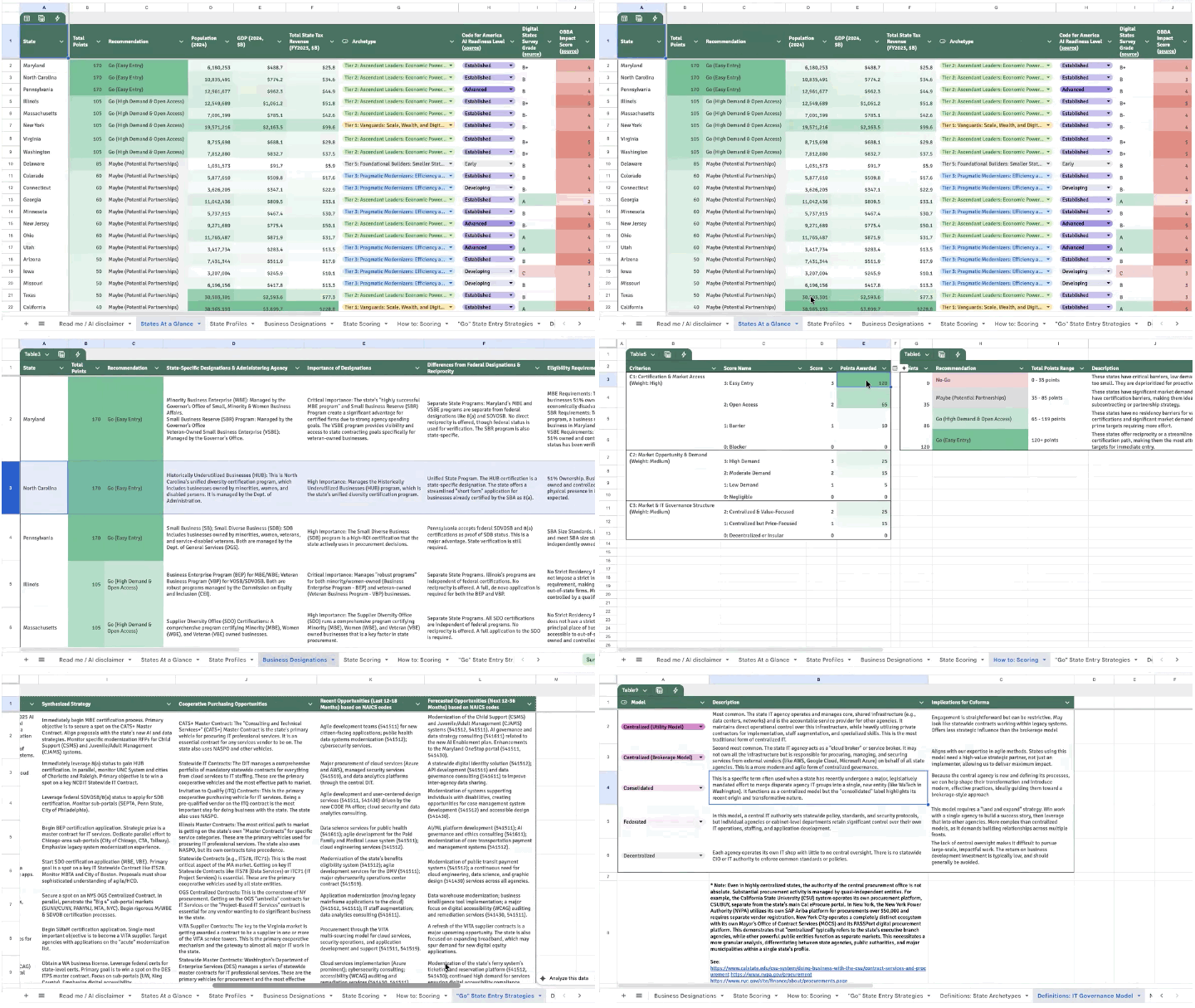
I first used AI to assemble comparative data across all 50 states, creating a common baseline that included stats like population, tax revenue, historical procurement data, and state-specific business designations such as Minority Business Enterprise programs.
I then layered in vetted third-party research that added nuance that raw economic data was missing. This included assessments of state AI readiness from Code for America, digital government performance from the Center for Digital Government, analysis of state DOGE activity from the Center for Democracy & Technology, and research from Multistate on how recent federal legislation could affect state revenue.
I used SME interviews to validate and challenge what I was finding, and AI not only to accelerate information gathering, but to stress-test the emerging analysis, looking for inconsistencies and patterns that warranted closer review.
Accounting for AI’s slant
While AI made it possible to analyze a 50-state landscape on a compressed timeline, I treated its outputs as hypotheses rather than facts. A challenge we came across early on was its tendency to overestimate Coforma's fit with historical procurement opportunities (a classic example of sycophancy). Manual spot checks allowed me to measure the degree to which its results overestimated fit, and I built that bias into our approximation of serviceable addressable market so it didn’t skew the ultimate scoring.
Translating data into priorities
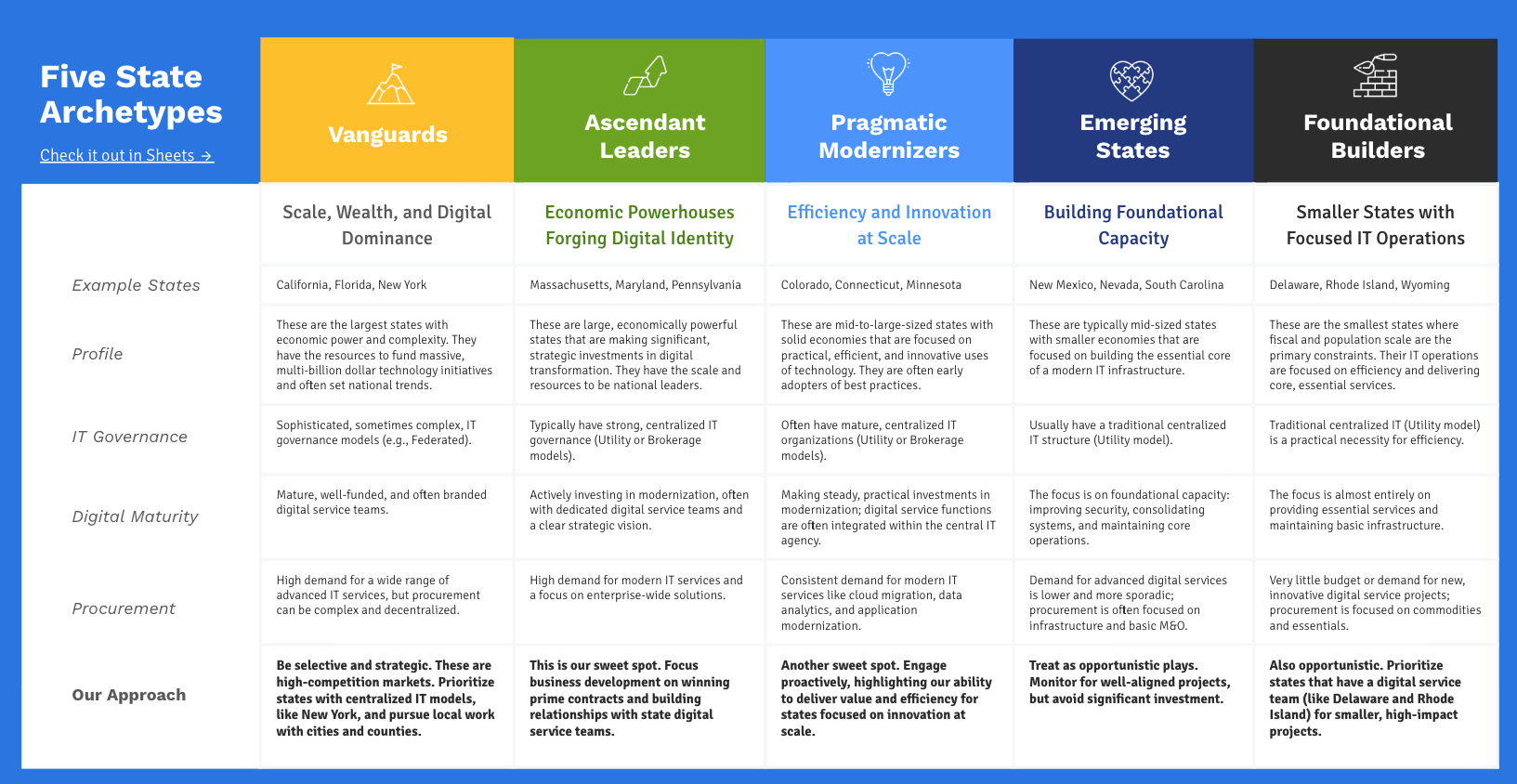
Rather than treating every state as an entirely unique case, I synthesized the research into state market archetypes. This made it easier for the Growth team to think strategically about where Coforma’s capabilities were likely to fit.
From there, I developed a scoring framework around three core dimensions:
1. Designations & Market Access — High weight
Accessibility of each market for a firm like Coforma, including state-specific certifications and set-asides, differences between state and federal designation systems, and eligibility requirements. The framework gave higher scores for states with strong certification programs, streamlined transfer of our federal credentials, and no residency barriers.
2. Market Opportunity & Demand — Medium weight
Size and health of the potential market alongside indicators of demand for modern digital services, including economic and fiscal conditions, digital-service procurement maturity, and the types of engagements states were pursuing. Higher scores were awarded to bigger markets with more maturity and demand for modern digital services.
3. Market & IT Governance Structure — Medium weight
How technology and procurement decisions were organized within each state. This included the presence of digital service teams and the degree to which procurement and technology governance were centralized or decentralized. This mattered because a large state with fragmented procurement could prove much more difficult to navigate than a smaller state with centralized governance and an established digital service organization. So I gave higher scores for centralized governance and established service teams, where it would be easier to build relationships and navigate standardized processes.
Impact
The framework has since shaped Growth's prioritization and contributed to several new bids. For me, the project reinforced a principle I aim to always bring to strategic research: the best strategy is not simply today’s answer—it's a participatory framework for helping an organization make better decisions as the landscape changes.